
Last updated
10 min read
Arim Roll Mecha Engineering Team
01 / OVERVIEW
One limits transmitted force; the other removes zoned drive
Minimum-pressure accumulation lets products touch while slip or reduced roller pressure limits the force added by each load. Zero-pressure accumulation divides the conveyor into zones and removes drive from an upstream zone when the downstream zone is occupied.
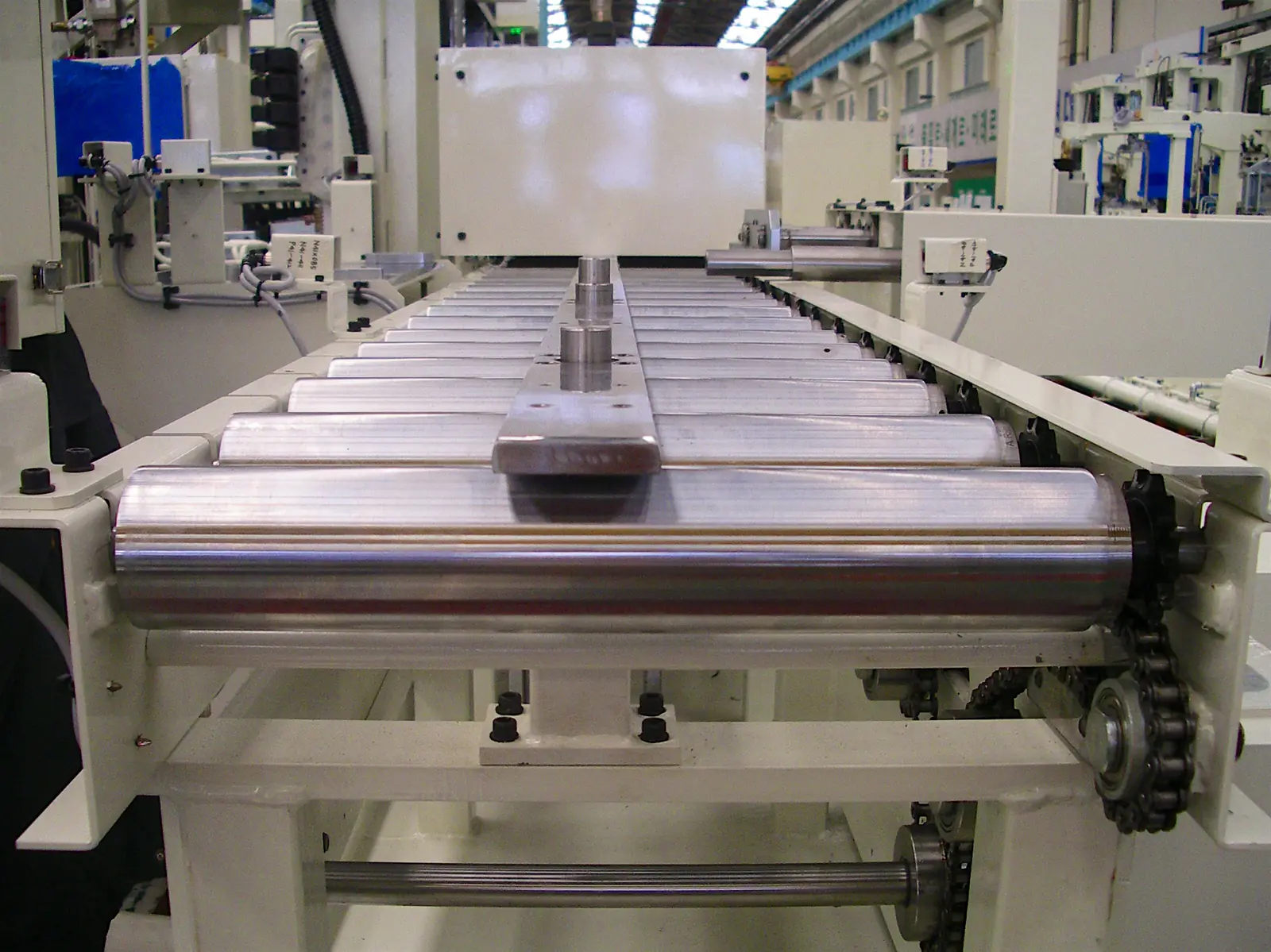
A minimum-pressure conveyor commonly uses friction rollers or adjustable pressure carriers so stopped rollers can slip while a shared drive keeps running. The architecture can be comparatively simple and packs products densely, but loads remain in contact and a residual force reaches the lead product.
Zero-pressure accumulation (ZPA) generally combines product sensors, independently controlled zones and release logic. An occupied downstream zone inhibits upstream drive, so no sustained driving pressure remains after the product stops. Whether it also prevents every momentary contact depends on system definition and stopping performance.
The useful question is therefore not which label is better. Evaluate allowable contact, product mass and conveying surface, required buffer capacity, release behavior, controls infrastructure and maintenance capability together.
02 / OPERATION
What happens when downstream flow stops
Both systems convey normally. Their difference appears when a product reaches a blocked downstream position.
Minimum-pressure accumulation
- The first load stops at a stop or downstream product.
- Following loads contact the queue and accumulate without gaps.
- Friction rollers or pressure devices slip to limit the force each load adds.
- When the stop clears, products restart without a zone-by-zone control sequence.
Zero-pressure accumulation
- A sensor detects that the downstream zone is occupied.
- The upstream zone motor or drive transmission is disabled.
- A zone normally holds one load and is sized around the longest load.
- When downstream clears, logic releases loads individually or as a controlled slug.
03 / COMPARISON
Engineering comparison
This table compares a representative centrally driven friction minimum-pressure system with sensor-controlled zoned ZPA. Actual performance varies by manufacturer and drive architecture.
| Criterion | Minimum pressure | Zero pressure |
|---|---|---|
| Product contact | Loads touch in a dense queue; residual line pressure remains | Normally maintains a zone gap; confirm whether zero contact is guaranteed |
| Drive and control | Shared drive with primarily mechanical slip elements | Sensors, zone motors or clutches, controllers and control logic |
| Buffer density | Little or no gap, so more loads fit in a given length | Zone length and safety gap can reduce loads per metre |
| Product protection | Good for robust loads when contact and rubbing are acceptable | Better suited to fragile, surface-sensitive or mixed products |
| Product variation | Mass and base friction directly affect slip and restart behavior | Limited by sensor detection, minimum dimensions and stopping distance |
| Energy | A central drive may run and rollers may slip during accumulation | On-demand MDR zones can reduce consumption in suitable duty cycles |
| Initial architecture | Often fewer devices and cables, with lower control complexity | More sensors, drives, wiring and commissioning as zone count rises |
| Maintenance | Inspect friction wear, spring or drive pressure, chains and belts | Diagnose sensor alignment, communications, motor rollers and wiring |
| Release control | A close-packed queue tends to restart continuously | Logic can provide singulation or controlled slug release |
04 / DECISION
Choosing the right accumulation method
Start with product-damage risk, then compare required buffer density and control behavior. This quickly narrows the suitable architecture.
Minimum pressure is a strong fit when
- Contact is acceptable for pallets, metal workpieces or other robust loads.
- A short buffer must hold products as densely as possible.
- A rugged mechanical system with fewer sensors and cables is preferred.
- Product mass and base condition are consistent enough for representative testing.
- Heavy loads or oil, dust and process debris require a custom mechanical design.
Zero pressure is a strong fit when
- Carton compression, surface marks or load-to-load impacts must be minimized.
- Mixed sizes and masses require individual tracking.
- Merges, sorters or robots need controlled spacing and release timing.
- Zone states must integrate with PLC or warehouse controls and diagnostics.
- Product protection and flexibility outweigh added control complexity.
05 / CHECKLIST
Six design inputs to define before requesting a quote
Sharing these operating limits with a supplier reduces overspecification and late changes on site.
- 01
Product range and base
Record minimum and maximum length, width, height, mass, base material, flatness and protrusions. For mixed flow, review the complete range rather than an average product.
- 02
Contact acceptance
Define whether close contact is allowed, residual pressure is limited, or even momentary contact is prohibited. Do not substitute the term zero pressure for a performance requirement.
- 03
Speed and stopping distance
At maximum speed and mass, include detection delay, coast distance and braking response when setting sensor, stop and zone positions.
- 04
Buffer capacity and zone length
Calculate required waiting quantity using the longest product and required gaps. A ZPA zone generally must be longer than the longest load it handles.
- 05
Release and throughput
Choose singulation, maintained gap or slug release, then verify peak hourly throughput under the worst accumulation condition.
- 06
Environment and maintenance
Include oil, coolant, dust, washdown, temperature and noise limits, plus local mechanical and electrical diagnostic skills and the spare-parts strategy.
06 / FAQ
Frequently asked questions
Q01Do products never touch on a zero-pressure conveyor?
Not necessarily. Some ZPA designs remove driving pressure but allow a load to coast into the next item. If contact is prohibited, specify zero-contact behavior and stopping distance at the maximum operating condition.
Q02How much pressure does a minimum-pressure conveyor create?
There is no universal percentage. Lead-load force depends on torque per roller, queue length, load mass, base friction and incline. Use model-specific supplier data and measure the complete accumulated queue.
Q03Does zero pressure always use less electricity?
An MDR system that powers only active zones can reduce energy versus a continuously running central drive, but zone count, control mode, accumulation duty and motor efficiency determine the result. Compare the actual duty cycle.
Q04Can zero-pressure accumulation handle heavy loads?
Yes, when zone torque, braking distance, frame and roller capacity, and sensor detection are all engineered for the load. Maximum-condition test results matter more than the marketing category.