
Last updated
8 min read
Arim Roll Mecha Engineering Team
01 / DEFINITION
Definition and purpose of an accumulation roller
An accumulation roller is a powered conveyor roller with an internal friction or slip mechanism that allows the roller tube to stop when the conveyed load stops, even while the common drive continues to rotate.
On a fixed-drive live roller conveyor, stopped products remain over rotating rollers. As more products arrive, pressure builds against the lead product and stop, which can mark the product base, compress packaging or increase drivetrain load.
A friction accumulation roller limits that pressure. When resistance exceeds its set transmission torque, the internal coupling slips: the roller tube stops while the drive element continues to rotate. Once the stop is released, lower rolling resistance allows the coupling to transmit torque again and conveying resumes.
This is a low- or minimum-pressure accumulation method. It is not the same as zero-pressure accumulation, where independently controlled zones keep products physically separated.
02 / PRINCIPLE
How the slip coupling works
Arim Roll Mecha rollers use spring preload and linear friction to establish transferable torque. Without external sensors or individually controlled motors, the set torque is transmitted as mechanical rotation of the roller tube.
01 · Conveying
Rotation passes from the drive shaft through the friction interface to the roller tube. When available torque exceeds the friction-resistance torque between the load and roller, the tube moves the load forward.
02 · Accumulation and slip
A stop or downstream product increases the required torque. When the set torque falls below the friction-resistance torque between the load and tube, the internal interface slips, the tube stops and the force added to the accumulated queue is limited.
03 · Restart
When the obstruction is removed, resistance falls below transferable torque. The tube turns again and releases the load without a separate reset command.
03 / COMPARISON
Fixed drive, friction accumulation and ZPA compared
The word accumulation does not describe one performance level. Product-contact requirements and control architecture determine the right approach.
| System | How it works | Primary benefit | Design consideration |
|---|---|---|---|
| Fixed-drive live roller | Every roller remains positively connected to the common drive | Simple construction for continuous transportation | Pressure and rubbing continue to rise during a stop; not intended for accumulation |
| Friction accumulation roller | An internal coupling slips above its transmission-torque setting | Reduces pressure without zoned controls and keeps a dense product buffer | Products remain in contact; representative testing is important because force is load-dependent |
| Zero-pressure accumulation (ZPA) | Sensors detect products and stop independently powered zones | Maintains a gap so products do not contact one another | Requires zone drives, sensors, controllers and wiring |
04 / SELECTION
Six factors for selecting an accumulation roller
Selecting by model name or total payload alone can produce insufficient restart force or excessive back pressure. Evaluate the complete operating condition.
- 01
Load per supporting roller
Divide the workpiece weight across the rollers actually supporting it. Workpiece length, roller pitch and center of gravity determine how evenly that load is shared.
- 02
Base and friction condition
A flat, rigid base is preferable. Pallet material, contamination, ribs, deflection and roller surface all change transmitted force and restart behavior.
- 03
Required drive torque
Torque must overcome rolling resistance and any incline during transport, yet allow slip before stopped products are damaged. Selection establishes a usable window between those limits.
- 04
Speed, queue length and dwell time
Line speed, the number of accumulated loads, stop frequency and dwell duration affect friction heat and the residual pressure at the head of the queue.
- 05
Mounting and load position
Confirm simple-beam, cantilever or sprocket drive geometry, along with product width and center of gravity. Eccentric loading and roller-height tolerances also affect reliable restart.
- 06
Temperature and contamination
A linear-friction drive is recommended for resistance to wash fluids. Tube material, surface finish and sealing are then specified for temperature, oil, metal chips and other site conditions.
05 / APPLICATION
Where friction accumulation fits
Friction accumulation is a strong fit for robust manufacturing buffers that need a simple mechanical response to repeated stops. If contact between products is unacceptable, controlled zones should be considered first.
Good fit
- Buffers between processes carrying engines, transmissions, battery packs and other heavy workpieces
- Lines where loads may touch at a stop but back pressure must be limited
- Rugged mechanical systems that minimize sensors and individual zone controls
- Custom equipment exposed to coolant, oil or metal chips
Consider another approach
- High-value, fragile or surface-sensitive products that must never touch
- High-speed automation requiring exact gaps, tracking and individual release
- Soft or irregular product bases with inconsistent roller contact
- Continuous long-duration accumulation where the common drive cannot be stopped
06 / CONFIGURATION
Roller configurations for the machine
The same friction principle can be packaged in different support and power-transmission configurations.
Simple-beam type
Supported by the frame at both shaft ends for stable load distribution and a wide range of roller face lengths.
Cantilever type
Supported from one side to preserve access on the opposite side. Shaft stiffness, deflection and eccentric load require careful review.
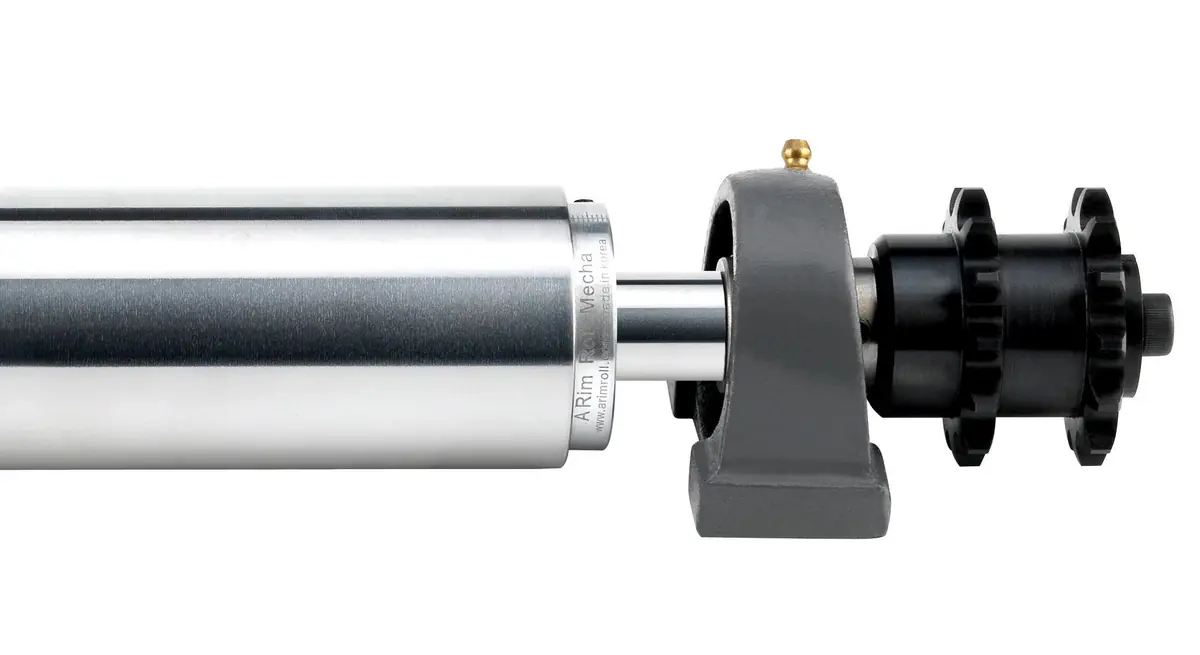
Sprocket type
Chain-driven for robust power transmission and heavier loads, configured to the required torque and chain specification.
07 / FAQ
Frequently asked questions
Q01Does an accumulation roller stop the conveyor motor?
Not in a friction system. The common drive may keep moving while the individual roller tube slips internally and stops. A ZPA system instead switches or decouples each controlled zone.
Q02Does it eliminate all pressure between products?
No. Friction accumulation is a minimum-pressure method, not zero pressure. Residual force at the first product depends on queue length, force per roller and contact conditions.
Q03Is more torque always better?
No. Too little torque can prevent restart; too much increases pressure and friction heat during accumulation. The correct setting transports reliably and slips before the load or system is overstressed.
Q04Can it be retrofitted to an existing conveyor?
Potentially. Frame width, shaft mounting, roller pitch and diameter, drive method and available space must be checked. Existing drawings and load data allow a standard or custom configuration to be evaluated.